
Microsoft Purview and Cyera: A Unified Approach to Modern Data Security
This article explores how Purview and Cyera integrate conceptually and operationally to deliver end-to-end data security, governance, and compliance at scale.
As organisations accelerate cloud adoption, data security challenges have shifted from perimeter protection to continuous data awareness. Enterprises now require both native control enforcement and independent, context-rich visibility across structured and unstructured data. Used together, Microsoft Purview and Cyera provide a complementary architecture that closes critical gaps in classification accuracy, risk prioritisation, and operational response.
This article explores how Purview and Cyera integrate conceptually and operationally to deliver end-to-end data security, governance, and compliance at scale.
The modern data security problem
Most organisations already have multiple controls in place—DLP, encryption, access management, and audit logging—yet still struggle to answer fundamental questions:
- Where exactly is our sensitive data stored across SaaS, IaaS, and PaaS?
- Is it over-exposed, duplicated, or retained longer than necessary?
- Are our security controls aligned to actual data risk, not assumptions?
Microsoft Purview: Policy-driven control and governance
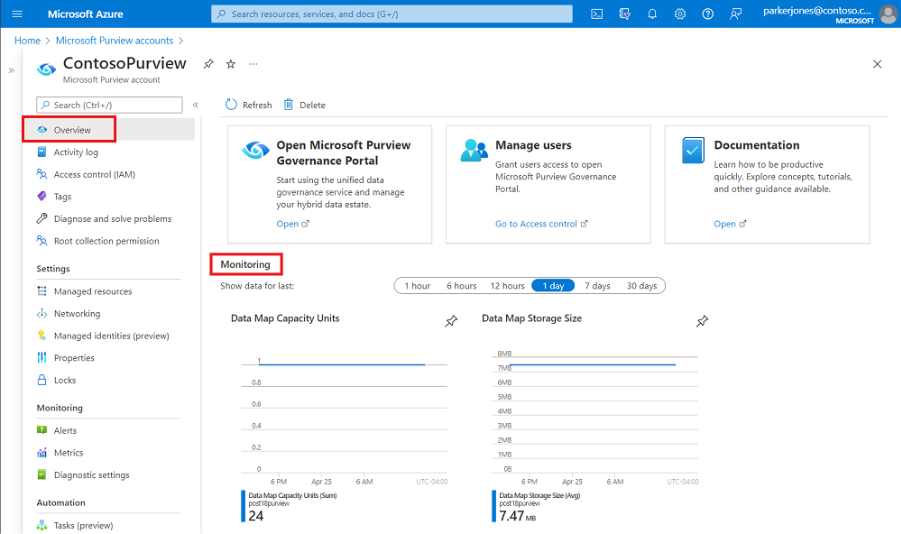
Microsoft Purview provides control-plane enforcement across Microsoft 365, Azure, and connected SaaS platforms.
Core strengths
- Information Protection
Sensitivity labels, encryption, and usage restrictions are applied at the file, email, and dataset levels.
- Data Loss Prevention (DLP)
Policy-based controls to prevent exfiltration across endpoints, cloud apps, and email.
- Data Lifecycle & Records Management
Retention, deletion, and regulatory hold controls.
- Audit & Compliance Manager
Evidence generation for ISO 27001, GDPR, and sector-specific frameworks.
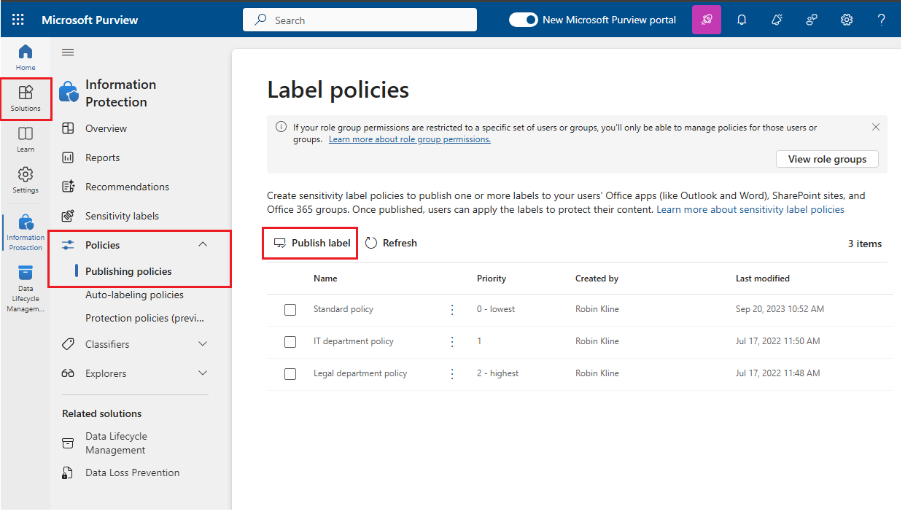
Limitations of Purview that cannot be solved by itself
Purview depends heavily on pre-defined classifiers and scoped data sources. Without an independent discovery layer, organisations risk blind spots—particularly in non-Microsoft cloud services and unmanaged data stores.
Cyera: Deep data discovery and risk context
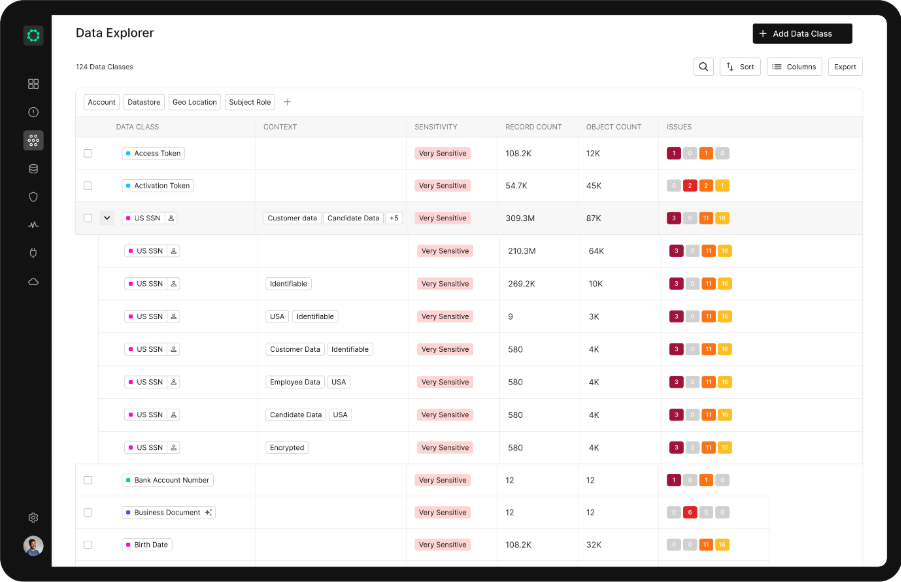
Cyera operates as a cloud-native DSPM platform, continuously scanning data environments to uncover what security teams did not know to look for.
Core strengths
- Agentless discovery across clouds and SaaS
Rapid visibility into S3, Azure Blob, Snowflake, BigQuery, Salesforce, and more.
- High-fidelity classification
Identifies PII, PHI, PCI, credentials, IP, and AI training data with contextual accuracy.
- Risk prioritisation
Highlights toxic data combinations: sensitive + public, sensitive + stale, sensitive + over-privileged.
- Exposure analytics
Who can access what, from where, and why it matters.
Limitations Cyera cannot solve alone
Cyera identifies risk but does not enforce encryption, DLP, or retention policies. It relies on downstream control platforms to take action.
Why Purview + Cyera is stronger together
1. Discovery-led governance
Cyera uncovers sensitive or high-risk datasets that were previously unknown or misclassified. These findings directly inform Purview label strategy, ensuring protection policies are applied where they matter most.
Outcome: Reduced false confidence in coverage; governance driven by real data, not assumptions.
2. Risk-based policy enforcement
Cyera identifies over-exposed or dormant sensitive data. Purview then enforces:
- Encryption via sensitivity labels
- Access restrictions via Microsoft Entra ID integration
- DLP policies for high-risk data flows
Outcome: Controls are applied selectively and proportionately, improving security without harming productivity.
3. Continuous compliance with evidence
Cyera provides evidence of:
- Data locations
- Classification accuracy
- Exposure trends over time
Purview provides:
- Policy enforcement records
- Audit logs
- Compliance scoring
Outcome: Strong, defensible evidence for ISO 27001, GDPR, and regulatory audits—without manual data mapping exercises.
4. Improved incident response and forensics
When a data incident occurs:
- Cyera identifies what data was involved and how sensitive it was
- Purview audit logs show who accessed or attempted to move it
- Purview DLP confirms whether controls were triggered
Outcome: Faster root cause analysis and materially better post-incident reporting.
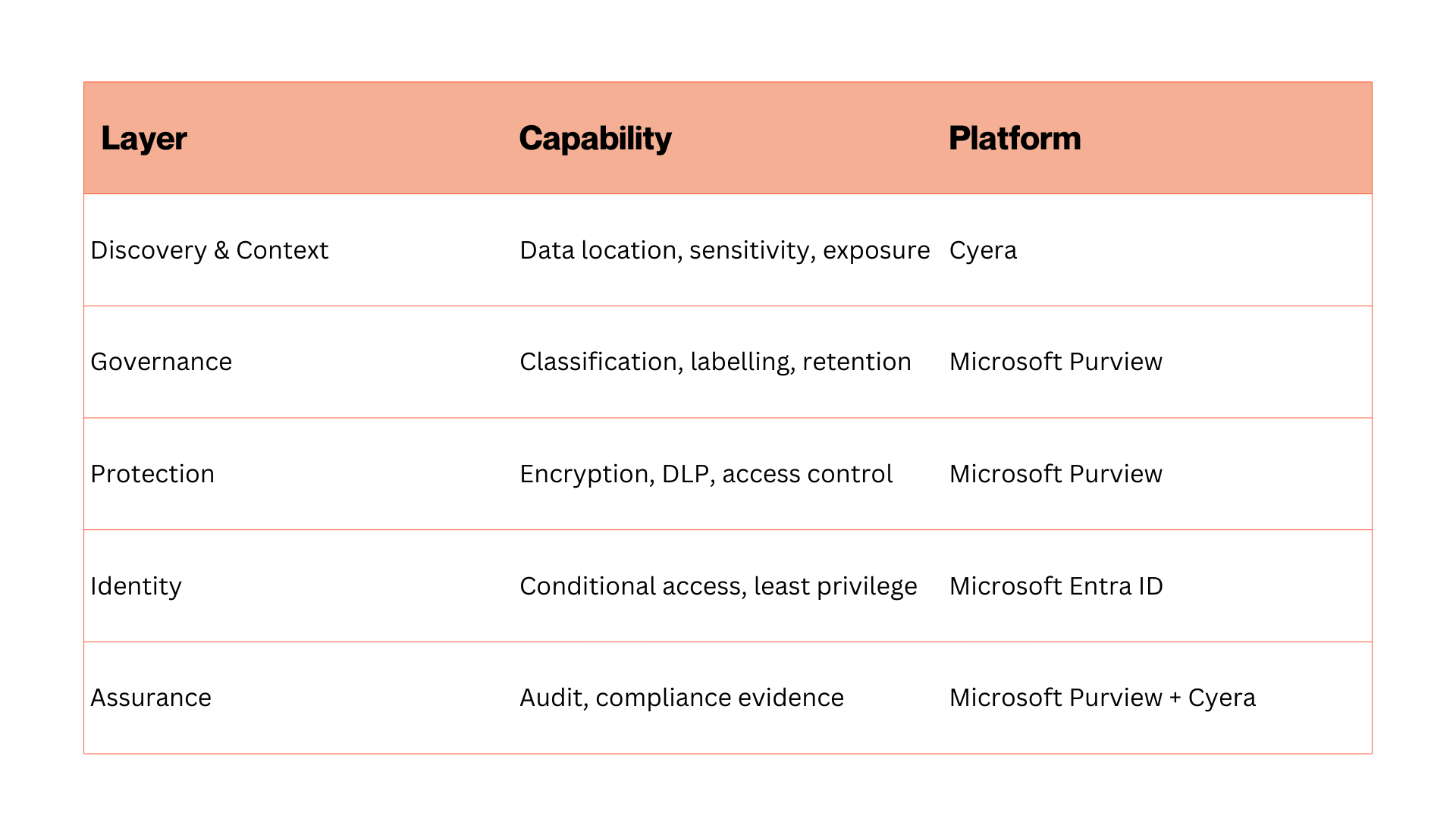
Use cases that benefit most :
- Cloud-first enterprises with Azure + AWS/GCP estates
- Regulated organisations (financial services, healthcare, legal)
- ISO 27001 programmes seeking continuous, auditable control evidence
- AI governance initiatives requiring visibility into training data and data lineage
Strategic takeaway
Microsoft Purview and Cyera address different layers of the same problem:
- Purview answers: “What controls should apply, and how are they enforced?”
- Cyera answers: “Where is our sensitive data, and what is actually risky right now?”
Together, they form a closed-loop data security model – from discovery, to classification, to enforcement, to assurance.
For organisations serious about modern data security, this combination moves data protection from a static compliance exercise to a living, risk-driven capability.

James Kavanagh
Chief Technology Officer


.png)
Get safer now
See how Managed Threat Detection can make a difference for you. No obligation free trial.

Subscribe to our weekly newsletter!
©2025 Cyber Vigilance
Powered by Disruptive
Naggs Stable, Old Portsmouth Road, Guildford, Surrey, England, GU3 1LP